
ChatGPT for Business: A Guide for Non-Technical Teams

TL;DR
49% of companies already use ChatGPT, but only 31% of European firms have a formal AI policy — the regulatory gap is real.
The EU AI Act takes full effect on 2 August 2026, requiring every company to document which AI tools it uses and for what purpose.
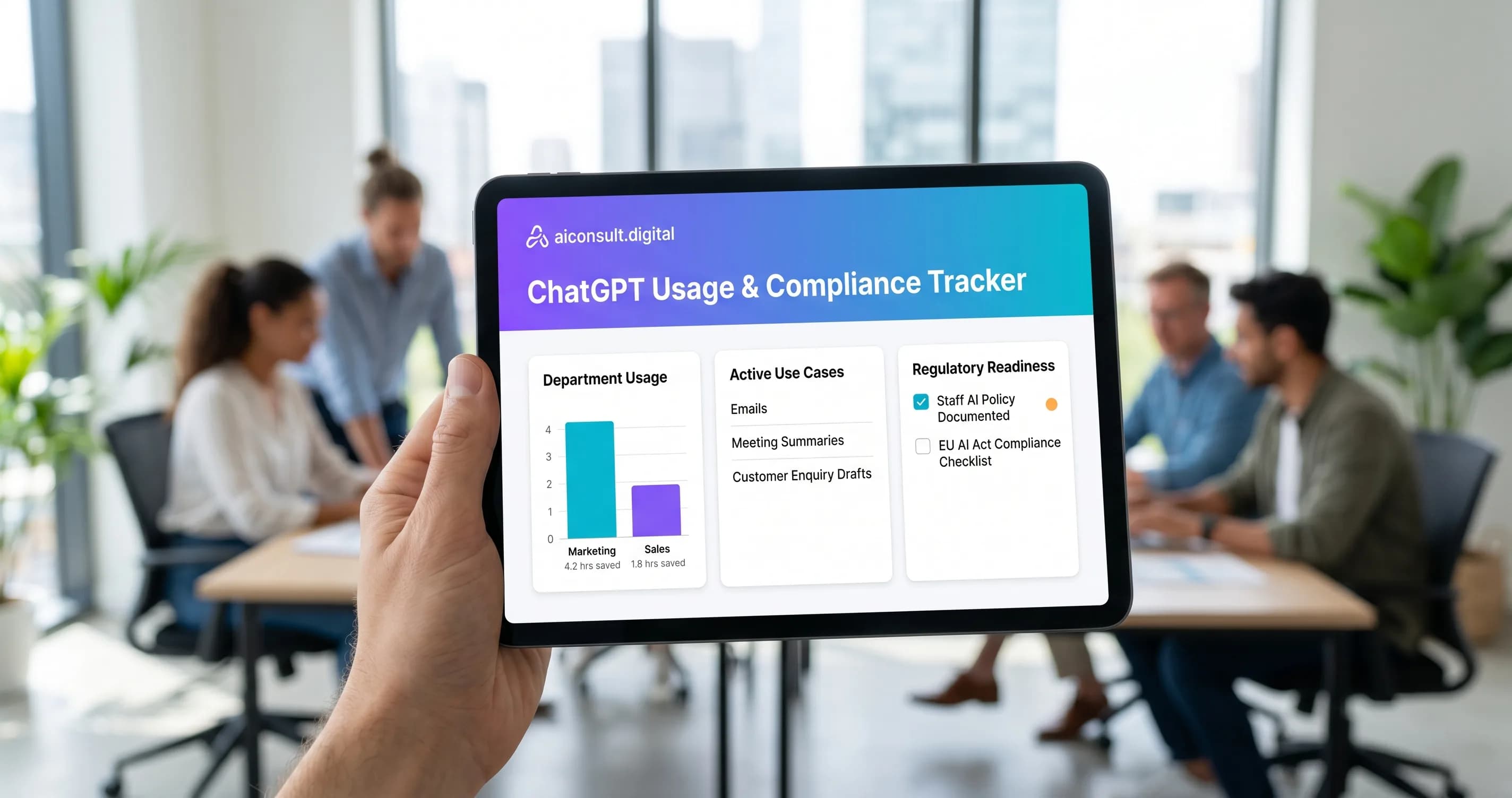
Marketing teams are cutting content production time by an average of 4.2 hours per piece without sacrificing quality.
Start this week with three low-risk use cases: emails, meeting summaries, and first-draft responses to customer enquiries.
Half your competitors are already using ChatGPT. Not as an experiment — as a working tool. According to data from early 2026, 49% of companies have integrated the model into daily operations, and 75% report positive ROI. The question is no longer whether to adopt it, but how to do it correctly — and quickly enough.
There's one complication most guides ignore: the EU AI Act takes full effect on 2 August 2026. Any company serving EU customers or employing EU staff must be able to show a documented register of the AI systems it uses. If you don't have one, you're not ready — even if you're only on the free plan.
This guide is written for managers, marketers, HR professionals, and sales teams — people who want real results, not technical lectures. You'll learn which use cases deliver the fastest value, how to avoid the most common mistakes, and what internal structures to put in place before regulators come knocking.
Before You Start: What You Actually Need
You don't need an IT department. You don't need a development budget. You need three things:
A ChatGPT account — the free plan covers most non-technical use cases. ChatGPT Team (around €25/user/month) adds stricter data privacy controls and admin oversight, which matters if your team handles client information. If you're unsure whether your business is ready for AI tools, take our free AI Readiness Assessment — you get a clear picture in 15 minutes.
Data hygiene rules — never enter personal client data, financial details, or trade secrets into the free plan. Data submitted there can be used to train the model. If your team works with sensitive information, ChatGPT Team or Enterprise is not optional.
An internal agreement — before rolling out, define what is and isn't permitted. Even a one-page document is sufficient to start and is the first step toward EU AI Act compliance.
Step 1: Choose Three Use Cases and Master Them
The most common mistake is trying to automate everything at once. The result is confusion — no one knows who's responsible for what and output quality drops.
Pick three specific tasks where lost time is obvious. Here are the categories with proven value:
Written communication — drafting and editing emails, proposals, and internal messages. The average employee loses around 2.5 hours per week on email correspondence alone. ChatGPT can cut that in half if you learn to give it specific context and a clear tone.
Summarising and processing information — turning long meetings, reports, or documents into concise summaries with key points and next steps. Particularly valuable for managers who attend many meetings.
Content and marketing — campaign ideas, post drafts, variations of advertising copy. Marketing teams using ChatGPT produce 180% more content at the same quality level — with 4.2 fewer hours of work per piece.
What a Good Prompt Looks Like
The difference between a useful and a useless response from ChatGPT usually comes down to the prompt. Three rules:
- Give context — "Write an email to a client" is a bad prompt. "Write an email to a B2B client in the construction sector who is 15 days overdue on payment. Tone should be polite but clear. No more than 120 words" — that's a good prompt.
- Assign a role — "You are an experienced HR manager. Help me frame feedback for an employee who consistently misses deadlines..."
- Iterate — if the first response isn't right, don't start over. Say: "Good, but make the tone more direct and cut by 30%."
Step 2: Organise Use Cases by Department
Different teams have different needs. Here are specific applications by function:
Marketing and Sales Drafting landing page variants, email campaign subject lines, and cold call scripts. Sales teams using AI to personalise proposals cut proposal creation time from 4.5 to 1.8 hours — and increase their win rate by around 12%.
Human Resources Around 40% of HR teams already use ChatGPT for CV screening, job description writing, and onboarding materials. The tool is particularly valuable for standardising communication during high-volume hiring periods. For structured onboarding of your whole team, see our AI Team Training programme.
Customer Service Agents supported by ChatGPT handle 13.8% more tickets per hour. The model helps draft responses to standard questions — the employee reviews and sends, rather than writing from scratch. Companies deploying ChatGPT in support handle 30–40% more enquiries with the same team size.
Project Management Drafting meeting agendas, structuring project plans, and turning discussions into clear action points. Managers using ChatGPT for administrative tasks save an average of 5+ hours per week.
Step 3: Build an Internal AI Policy (Before August 2026)
This is the step most SMEs skip — and the one that leaves them exposed. The EU AI Act takes full effect on 2 August 2026. Companies must have:
- An AI tool registry — a documented list of every AI solution you use, its purpose, and its risk classification under the Act
- A staff AI policy — what is permitted, what is not, and how AI-generated content must be labelled (required under Article 50 of the Act)
- Supplier contracts reviewed — confirm your agreements with OpenAI (or another provider) cover GDPR personal data processing requirements
Fines under the EU AI Act exceed GDPR maximums — up to €35 million or 7% of global annual turnover for the most serious violations. GDPR caps at 4%. To understand the specific financial exposure for your company, use our ROI Calculator.
ChatGPT, as a generative AI tool, does not fall into the high-risk category under the Act — but transparency is required: content generated with its assistance must be identifiable as such.
Common Mistakes and How to Avoid Them
Mistake | Consequence | Fix |
|---|---|---|
Entering personal client data into the free plan | GDPR violation, loss of client trust | Use anonymised data only, or upgrade to a paid plan with privacy controls |
Publishing AI content without human review | Factual errors, reputational damage | Every AI-generated text goes through a staff member before publication |
No internal policy | Regulatory exposure under EU AI Act audits | Create a one-page rules document by the end of the month |
Expecting perfect output from the first prompt | Frustration and tool abandonment | Iterate — good results come after 2–3 refinements |
One "AI champion" in the company | Dependency on a single person, risk if they leave | Train at least one representative from each department |
What to Do This Week
Don't wait for a perfect plan. Three concrete low-risk steps with fast returns:
- Pick one person from marketing or sales and give them a task: test ChatGPT on 5 real tasks this week. Ask them to note how much time they saved and what the quality was like.
- Write one sentence of AI policy: "Staff may use ChatGPT for [X, Y, Z], but must not enter [personal data / financial information / trade secrets] without manager approval." That's enough to start.
- Register ChatGPT in an AI tool registry — even in an Excel spreadsheet. Columns: Tool, Purpose, Department, Data Type, Risk Category. Start with a low-risk classification and document it.
If you want to take the next step with a more structured deployment, explore our AI Strategy & Consulting service — we help companies build AI strategies that deliver results and meet regulatory requirements.

Article written by
Toma Tomov
AI integration, data modelling, and business process automation specialist with over 10 years in the technology sector. Works with companies to reduce manual operations and deploy AI solutions across live workflows. Holds five professional certifications in artificial intelligence.

Практически съвети за успешна интеграция на AI технологии в съществуващите корпоративни системи без прекъсване на работата.

Кои са най-актуалните статистики за чатботове в онлайн търговията и как влияят на продажбите, конверсиите и клиентското обслужване.